Thursday, August 26, 2010

Tatsumi's "Hell" - A 'Manga' Review


Fiction that posits itself as ‘truth’ has always drawn a strong scepticism from me. How can something that’s not only reliant on authorial interpretation in the first instance but concurrently obliged to uphold storytelling conventions (characters, plot structure etc.) to be appealing assume status as ‘fact’? Don’t get me wrong; I’m sure Dickens’ work has a resonant ‘truthfulness’ that correlates with other representations of the time period. And James Joyce’s Dubliners, a set of short stories that articulate a melancholy permeating daily life in the Irish city, happens to be a favourite of mine. But the point I stress when dealing with fictions that either comprise the ‘realist’ movement of storytelling or function as proposed social commentary is that it is a representation, not the representation. A whole nexus of experience makes up the public consciousness of a place and/or population; not every voice can be accounted for in the one story.

That’s not to suggest that fiction can’t be ‘accurate’ or ‘persuasive’. In the case of Yoshihiro Tatsumi’s “Hell” – a harrowing examination of the Hiroshima bombing in 1945 and its subsequent exploitation across political and professional realms – the question of ‘accuracy’ is impossible for me to answer but the starkly evident research enveloping the narrative hints of an informed perspective; one that troubles the nerves with its drab depictions. Along with the other bleak tales in the collection Good-Bye, which brings together several of Tatsumi’s ‘manga’ short stories dating from 1971 to 1972, “Hell” details an existence that is unrelentingly dreary and doesn’t cater towards readers who stubbornly cling to optimistic ‘happy endings’.


It’s interesting to note an author’s textual strategies in constructing ‘authenticity’. Tatsumi utilises famous landmarks and faces in “Hell” to construe his story as ‘truthful’. The placement of identifiable buildings / locales in his stories is a recurring technique throughout Tatsumi’s Good-Bye; even to the point of becoming central to the plot a la “Just a Man”. In “Hell” the Hiroshima Peace Memorial – pictured in the artwork and the photo above – becomes an overbearing, haunting motif pursuing the protagonist. Its silhouette is always present during Mr. Koyanagi’s darkest moments. In this sense the imagery acquires further meaning: on one hand it consolidates Tatsumi’s attempted ‘realism’; on the other hand the building’s symbolic baggage as a memorial for Hiroshima is drawn upon, suggesting it’s ever-present in the lives of the Japanese. There’s a precision felt in the ‘real’ locations, such as the Hiroshima Peace Memorial, depicted that sticks out from the other scenery. They acquire salience, attracting the eye to them and the meaning(s) they contain. Detail, as emphasis, appears to be a significant tool in Tatsumi’s repertoire, additionally perceived in the contrast between the cartoon-y characters and Prime Minister Sato’s realistic likeness. This helps to highlight one of the concerns underlying “Hell”; the political exploitation of the Hiroshima bombing. It’s very clear who is implicated in it too...


What’s remarkable about Tatsumi’s attempt to document via realism is the research that bolsters such intention. The devastation of Hiroshima is grimly depicted: charred corpses, hideously burnt victims, black rain, shadow burns etc. Tatsumi has investigated the physical effects of the bombing excessively in order to envelop his character’s experience in ‘fact’; another strategy in accruing ‘authenticity’. He even directly references the infamous shadow burn on the steps of Sumitomo Bank (photographed above). Working with shades of grey, black and white he still manages to craft a disturbing, graphic visual account. He even lingers on this subject matter for a few pages, literally having Mr. Koyanagi tour the apocalyptic wreckage, before returning to furthering the plot. This highlights an appreciated dedication to his work, particularly the social commentary, beyond simply telling a great story.


There is a profound ambiguity that penetrates “Hell”. The proliferation of dual meanings, without cementing one or the other as ‘truth’, builds magnificently towards the final, overwhelming moment. At one point, looking over Hiroshima’s rubble at sunset, Mr. Koyanagi expresses this running theme of duality: “The stench of hundreds of thousands of corpses drifted by ... but the sunset was unbelievably beautiful.” The symbol of Hiroshima’s destruction is, paradoxically, rendered both ‘horrid’ and ‘beautiful’. This theme becomes enmeshed in the plot: Mr. Koyanagi, having discovered the remarkable shadow burn of a son giving his mother a backrub, sells its photograph to the media. However the stunning revelation is that this morbid symbol is actually the last evidence of a murder scene. What has been circulated as a symbol of peace, of compassion and devotion now, concurrently, becomes a symbol of murder and greed; a transition further enhanced by Mr Koyanagi’s consequent actions. He murders the only man who knows of its ‘real’ meaning. But it’s never clear whether Koyanagi is motivated by professional greed – to safeguard his reputation and employment – or to keep the public’s faith in the symbol’s positive meaning. At numerous times Koyanagi hints at pride in his newfound status, even to the point of alleviating his guilt at using the death of others for financial gain. Conversely, after finding out the less benign meaning in the photograph, a bunch of citizens approach Koyanagi to thank him for the hope his photograph has brought the Japanese people. At this point he begins to contemplate murder; the greater good seemingly being the driving reason. But, moments before lifting the rock to pummel his enemy, another reference to the professional gain he stands to lose occurs. It’s never truly clear what motivates him in the end. And likewise all the dual meanings filtering through the plot are never confirmed satisfactorily either way. The only certainty to emerge through the dreariness is Mr. Koyanagi’s capacity for murder. What a bleak, bleak tale.


My ambition with this analysis/review of Yoshihiro Tatsumi’s “Hell” is not to encourage scrutiny of it, or any other text, that attempts to contribute understanding to existences and experiences of real places, real people, real events. Whilst I maintain that a degree of scepticism is essential, underpinned by the knowledge that texts are artificial constructions guided by subjective viewpoints and textual obligations to manifest widespread appeal, that doesn’t nullify the compelling and shocking argument that Tatsumi puts forth. In identifying Tatsumi’s techniques in brewing ‘authenticity’ I’m not hoping to undermine the validity of his claims; how can I? Instead I’m hoping to present awareness of those very same masterful techniques that work together to craft a captivating, poignant vision. This is a masterpiece, and one of the best ‘comics’ I’ve ever had the pleasure to read. I enthusiastically encourage others to buy Tatsumi’s Good-Bye collection.

Monday, August 9, 2010

I can't think of a title for this entry so lets just call it WRASSLIN'~!

Rock N Roll Express vs. Dirty White Boys - 05.11.85

Heh. The '80s witnessed some of the silliest names for tag-teams. [Then again: They aren't the ones running around being called the 'Dudebusters' ... yikes ...] Fun tags were as plentiful as seconds in a day back in the territories. So what makes this one remarkable over the others? Well, nothing really. We begin with an amusing stretch of dominance by the Rock N Roll Express, with several spots that make the dastardly heels look like absolute fools. This builds nicely to the sudden switch in momentum, with one of the Dirty White Boys nailing a clothesline, which Ricky Morton sells like a gunshot. The jolt this causes in the feel of the match is impressive; one second everyone is jovial, to next there's a hush. This evolves into a neat FIP middle, with Morton milking comebacks at the right moments to prevent the performance from becoming dull. Then we have the inevitable hot-tag to Robert Gibson leading into the finish. For a match that took place in what appears to be a high school gymnasium, the engrossed crowd and the match they deliver exceeded expectations.

Dolph Ziggler vs. Chris Masters - WWE 05.13.10

Who would've thought we'd have a Full Nelson v. Sleeper Hold story in a contemporary pro-wrestling match? Let alone in the WWE? Ziggler's bumping complements Masters' strike/power-based offense superbly. This creates an entertaining opening stretch that develops gradually to an impressive spot on the outside whereby Masters takes an unguarded fall to the ground back first a la Foley. Like the clothesline in the above review, this moment 'feels' significant. The turn in the match is felt. Once we get to Masters' comeback sequence it's pleasing to see the big guy maintain a sense of 'fatigue' in building momentum. It takes several clotheslines before he's officially in his 'second-wind', moving gradually quicker, fresher with each one. Meanwhile he's making Ziggler do all the running (throwing him to the ropes, for example, and nailing a high-impact move on his return) to prevent any impression of no-selling. Throughout we have running references to both performers' submission finishers, whether it be early attempts to use them or deployed rest-holds that the commentary weave into being important for their future application, keeping alive the battling time-tested submission hold theme. In the end we have a cool interchange of counters to both holds, ending with a surprise Zig-Zag by Dolph for the win. The second best WWE television match I've seen this year.

Wednesday, July 28, 2010

Red Dead Redemption


[The reader is warned that the following piece makes plot points, particularly the ending, explicit. Don’t read if you wish the avoid spoilers.]

The ‘western’ landscape is a melancholic one. That’s the lingering impression of Rockstar Games’ latest foray in the genre: Red Dead Redemption. As Ashtar Command’s moving track “Dead Man’s Gun” partners the credits one realises they have been taken on an emotional journey; one that only digs deeper the further you progress, that ditches the usual explosiveness of the final missions of Grand Theft Auto IV and San Andreas for one of poignant resonance. Rockstar Games have always been ‘bold’ with their products. But this is a different kind of daring than that exhibited in their biting satire and audacious courting of controversy; this is a daring located in the very process of storytelling. They reveal that beneath the lewd humour, colourful characters and ludicrous situations – all still present – lies the capacity to convey an affecting narrative.

Grand Theft Auto IV indicated that Rockstar Games had a maturity in storytelling, producing the closest thing to a ‘character study’ yet in their body-of-work. Red Dead Redemption offers a worthy, at times superior, continuation. The main narrative is familiar territory for fans of Grand Theft Auto: an ex-criminal attempting to escape from the past only to be drawn back into it involuntarily, inescapably. Obvious from the game’s title is the theme of redemption; what’s not immediately apparent is how that theme actually transplants itself to be felt by the gamer. Like Niko Bellic in Grand Theft Auto IV, Marsten must hunt down figures from his past. Along the way a host of characters manipulate and use Marsten, dangling that carrot in front of him to get what they want without returning the favour. One particular mission struck me; in Mexico, Marsten is enlisted to help quell a rebellion by the government with the promise of aid in his quest resultantly. After completing this mission, having killed all the peasants and burnt their houses (manually), a cut-scene portrays several Mexican soldiers taking away the now widowed wives. Their fate that you, the gamer, cemented is one of rape and probably murder. The sense of outrage at this image rocked me; I hoped against everything that I’d have a chance to make up for this. In a way Red Dead Redemption provoked within me the longing for redemption, crafting empathy for the John Marsten character rarely achieved, for me, in a video game.


This same interactivity that shifts the gamer’s sensibility is repeated in Red Dead Redemption’s conclusion. Without hyperbole, it’s the most evocative stretch of gameplay I’ve encountered. What seemed mere novel distractions during the course of the game (horse-breaking, herding cattle, hunting etc.) transform into powerful storytelling devices once Marsten has fulfilled his enforced obligation in bringing his former gang cronies to justice. With wife and son released safely, the Marsten family return to their ranch. You get to take part in rebuilding the property, the missions concurrently focusing on John forging a bond with his son. This is what you were fighting for throughout the game, to reunite John with his family, and you get to take active part in it. Teaching the son how to hunt and herd cattle; it’s a lovely set of missions. But it’s also unsettling. This can’t be the end of the game; it’s too anti-climatic. It’s not the end of the game and, soon enough, those same government agents that blackmailed Marsten reappear. Storming the Marsten ranch with a ridiculous amount of soldiers, the inevitable fate is overbearing. The tragic ending - I won’t say in what way it’s ‘tragic’ – is becoming of the genre, recalling similar themes in Eastwood’s masterpiece Unforgiven and McCarthy’s equally bleak neo-Western No Country for Old Men. And therein lies Rockstar Games’ ‘boldness’, forgoing the ‘happy ending’ for an end result that’s both moving and faithful to the greatest interpretations of the genre.

The sheer beauty of Red Dead Redemption’s world cannot be left unsaid. Rockstar Games have an impeccable gift in crafting areas rich with character and variation. Grand Theft Auto IV achieved this impression with the cityscape; not a building design seemed copied-and-pasted, each region had a distinct ‘look’ which subsequently fragmented into several recognisable areas or districts. Their attention to detail is amazing and seemingly ushers in a Joycean view wherein certain locations, from mundane street corners to parks and factories, acquire meaning / significance through experiences had in-game. Driving down most streets yield some sort of memory that enhances the distinctiveness of each area. This leaves the empty, mere functionalist design of GTA clones a la Saints Row rather lacklustre in comparison; it’s simply impossible for that same phenomenon to occur in a game where every building, every street, looked the same.


Red Dead Redemption achieves this same effect, despite having less ‘landmarks’ to work with. Unlike Neversoft / Activison’s GUN, which felt unforgivably small in scope and void of life, Red Dead Redemption is expansive and brimming with inhabitants. Randomly generated events appear as you ride around, sustaining contact with humanity in what could’ve been a very lonely existence. Moreover the game offers a fully-fledged ecosystem that dominates the unsettled countryside. The excessive amount of species is astonishing – ranging from rabbits, raccoons and armadillos to bears, cougars and buffalo. Predators hunt smaller prey. Vultures gravitate towards corpses. Coyotes and wolves hunt in packs; cougars and bobcats go it solo. The dedication to research, especially exemplified in their realistic movements, is admirable and allows for a vibrant virtual world. Contributing to this is the variation in appearance each region contains. West Elizabeth has rolling plains, dense woodlands, snow-capped peaks and cobblestone streets; New Austin the standard cactus-riddled desert; Mexico is flatter, redder and dotted with smoother rock formations. With what may have felt a limited design scheme initially, Rockstar Games prove they are just as adept at constructing an interesting countryside as they are cityscapes.

Tuesday, July 20, 2010

Trialling Kafka


Despite articulating an unnerving account of a bureaucratic system ushering in totalitarianism, what’s initially striking about Kafka’s “The Trial” is just how damn funny it is.

“The woman waved her hand to K. down below and tried to show by shrugging her shoulders that she was an innocent party in the abduction, but there did not seem to be much regret in this gesture.” (Kafka 1994: 47)

The event described is actually rather horrible; a married woman being abducted under the orders of an examining magistrate. It’s one of many warnings Kafka delivers in relation to the abuse of bureaucratic power. However the image is invested with dark humour: a bandy-legged man running off with a woman over his shoulder, the abducted reacting with nothing but a shrug. The frank description, combined with the indifferent body language of both the abducted woman and Joseph K. (the protagonist), transforms something shocking into an unremarkable, even amusing, occurrence.

In my opinion this dark comedy presents, rather than obstructs, the most important message derived from Kafka’s “The Trial”. By laughing, chuckling or even suppressing a giggle we effectively reveal in ourselves the potential indifference that this bureaucratic totalitarianism instils in its oppressed denizens. I laughed at a woman being forced to submit to a state official’s desires; the capacity to accept bureaucratic dominance is in me. This function performed by the text may be absent for some. But for me it is all too clear what reading “The Trial”, my first encounter with Franz Kafka’s work, has exposed.

Thursday, July 15, 2010

Frank Miller's Sin City - The Hard Goodbye


Miller's "Sin City - The Hard Goodbye". A gluttonous indulgance in style over substance. But isn't that the point? Marv, sadistic monstrosity and protagonist, commences a blood-soaked rampage for vengeance in honour of the one woman - a prostitute, naturally - who gave him a night of 'pleasure'. As the brute slaughters toward the horrible truth, we encounter instances of rampid corruption, depravity and lust that characterise the city's populous.

Hardly literature.
Hardly pretending to be.

"I'm staring at a goddess. She's telling me she wants me. She sounds like she means it. I'm not going to waste one more second wondering how it is I've gotten so lucky." (p.10)

A far reach from the rythmic eloquence of Chandler, Frank Miller nevertheless grabs the noir / hard-boiled genre and thrusts it into even grittier, ultraviolent territory. Whilst claims of re-inventing the genre may be exercises in hyperbolic praise "Sin City", at least here, does provide a fresh tangent. For the most part generic staples remain intact: the characteristic interplay between light / shadow; overbearing bleakness in the visualisation of setting and situation; inescapable doom of an ill-fated main character; the femme fatale(s), capable of navigating the darkness with their intellect and body etc. Everything just happens to be bolstered to gruffer, darker proportions. And stamped with liberal doses of blood splatter.


Striking in Miller's artwork is an interesting experimentation with shadows / darkness. His mostly minimalist approach to detail, evidenced above in one of my favourite frames of this or any graphic novel, crafts a mood and look that's both appropriate for the story and surprisingly rich despite the lack of colour. The panel is mainly black, leaving the small details illuminated by Marv's lighter to acquire significance. Why did Miller choose to include them? The bandages, reminding of the violence recently seen. Nancy's barely visible breasts, suggesting lurid meaning. The small cross pendant; perhaps a cheeky stab of Miller's in relation to the hinted violence and sex? Or a small nod at where Marv's quest ultimately lands him?

Obviously such a colour (tone?) scheme would become tired rapidly if not interchanged with brighter, detailed moments. In some instances, Miller inverses what's displayed above. Shadows reveal details, rather than occlude, thusly positioning light in the previous role of dark. In "Sin City", are 'light' and 'shadow' one and the same? Or is Frank Miller just being playful? Who knows, but it's an intriguing visual dynamic than once again exposes space for experiment in a seemingly limited colour/tone scheme. Facial expressions and action present the usual Miller roughness, an aspect of his artwork that neither amazes or annoys yours truly.

Want a gruff, violent story that doesn't attempt to noogie your brain cells? A story where its female characters never seem to wear tops? Something that tries to do something with its noir-ish colour/tone scheme? Get "Sin City - The Hard Goodbye". Who reads Frank Miller for complex, thought-provoking narratives anyway?

Wednesday, July 14, 2010

Film Review #1: Shutter Island

[If you're anxious about spoilers avoid this piece.]


Rarely do film adaptations eclipse their source material. However it'd be difficult not to here. Not even a quarter into Dennis Lehane's original work I'd figured out two-thirds of the 'twist'. The rest not long after. An unforgivable sin for a 'psychological thriller'.

Telegraphed clues ultimately betrayed Lehane's "Shutter Island". Consequently, I clearly had a different experience viewing Scorsese's adaptation than most. Engaging with Teddy Daniels' plight and the 'twist' was impossible. Furthermore assessing the film's clues becomes extremely hard. I knew what to look for. Would I have even noticed them had I not touched the novel? How revealing were they? I can't confidently answer either.

Despite this both Mark Ruffalo and Ben Kingsley do well to hint, but not over-emphasise, through their portrayals. DiCaprio, almost always reliable, dusts off the Boston accent from "The Departed" delivering a solid, if unremarkable, performance as US Marshal Teddy Daniels. Shutter Island is beautifully, and accurately, realised on screen. Gloomy, foreboding. It isn't hard to imagine someone unfamiliar with the plot being sucked in by the locale, atmosphere and actors. There are moments of inspired direction, as expected from Scorsese. The sliding shot displaying hundreds of Nazi guards being executed stands as one memorable sequences.

Some omissions do stick out uncomfortably. Shame that the cause of Dolores' manic depression isn't communicated. Those flashbacks were some of the more poignant and unsettling parts of Lehane's novel, not to mention contextually relevant. The dream sequences and Daniels' fractured characterisation, also, still feel far too (potentially) obvious. How can a man so blatantly troubled be anything but unstable?

Scorsese's slightly altered conclusion delivers one final 'shock', greater than the novel's. For a film that barely excited due to exterior influences, it still managed to surprise and provoke thought. However, like Lehane's book, it did fail in what it strived for. Like Nolan's amazing "Memento", "Shutter Island" attempts to fabricate the experience of mental disorder - schizophrenia specifically - for the audience. The inability to engage in Daniels' story, and subsequently to 'feel' its jolting upheavel, severely impairs the realisation of this effect. Whether that's a flaw of the film or simply my having read the novel isn't clear. It would be best to try it out for one's self.

Martin Scorsese is a better storyteller than Dennis Lehane. And the story itself is intriguing should you remain ignorant of the telegraphed moments. As such, although critical of his book, full credit absolutely goes to Dennis Lehane for having the initial and ambitious vision.

Sunday, July 11, 2010

Boston Legal S2E6 Witches Of Mass Destruction

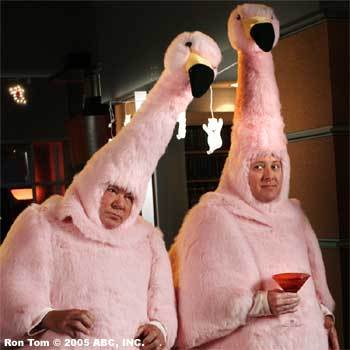
Trading men-in-tights for men-in-flamingo-suits today. Not sure if that's an improvement. Whatever. Boston Legal. A law court dram-com. Stars William Shatner, best known as Star Trek's Captain Kirk, and James Spader, who has probably starred in something else. It's a demented show; sometimes funny, sometimes serious, sometimes failing at both.

Season 2 has been somewhat disappointing. Utter letdown, actually. So far. With over twenty episodes to go, I'd be naughty to suggest this applies to the season's entirety. And with the sixth episode, things are promising.

For me, Boston Legal is most entertaining when tackling difficult subjects. Yeah the silly get-ups, sexual innuendo, absurd cases ... They are amusing. Occasionally. But the show peaks when it anchors that stupidity with real purpose, a point. Something that makes you tighten those eyebrow muscles. Presumably in thought. Take here: Alan Shore, providing another pendulum swing between seedy sleaze-bag and justice upholder, challenges the controversial 'Stop-Loss' program. This sub-plot becomes an impassioned plea for opening discussion on, to actually allow space to talk about, the military's unaccountability for lost life. A compelling argument made more powerful by Shore's dealings with friends and colleagues.

Brad and Denny Crane, respectively, present discourses of 'pride' and 'nationalism' that stunt conversation about the army's culpability. Watching Shore face vilification, from friends, simply for taking a stand is moving. The writing's quality, however, isn't just its argument but its manner in navigating these sensibilities held by Denny and Brad without condemning them. Because, as the failure of Shore's case shows, the episode's point isn't to demonise the army, its troops or the war effort but to make room for the voicing of concern. And to present the articulation of this concern as not automatically dishonouring the sacrifices of troops or inciting treason. That is the episode's most valuable point. The judge, visibly moved by Shore's persuasive words, blatantly struggling with his ruling in favour of the army's defense highlights how we first need to free ourselves from anxieties of 'honour' and 'nationalism' before we begin to try and shape the nation's legal fabric.

The other case provides comedy to run concurrently with the thought-provoking material. That said, it also has a significant issue at its heart: bringing to attention the sensitivity of minority religious groups (Wiccans) when it comes to popular representations and motifs (the wicked witch and its prominence in Halloween themes). It's tough-in-cheek stuff, but refrains from being insulting or blunt. And, by the case's end, it too manages to place in one's mind a caution towards certain understandings of groups that are incapable of expressing themselves amidst more wide-spread imaginings.